It’s not a slogan.
It’s not a joke.
And it’s not subtle.
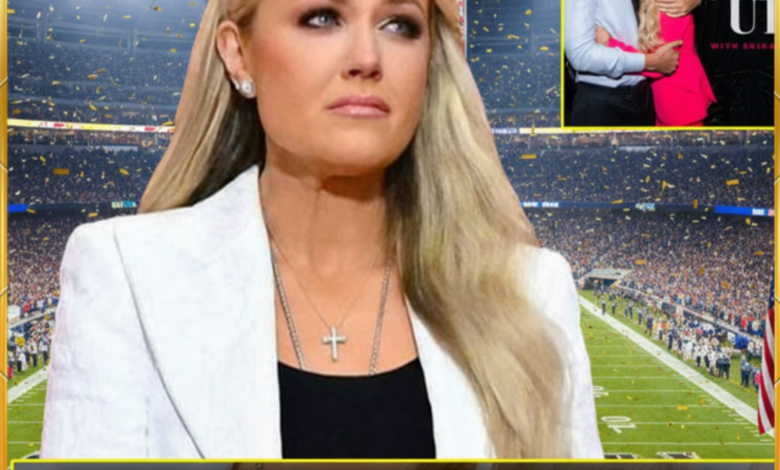
As Super Bowl anticipation reaches its annual peak, Erika Kirk has issued a challenge that’s cutting straight through the noise: turn away from the spectacle and tune into something real.
With those four words — “Turn off the Super Bowl” — Kirk has ignited a conversation that goes far beyond ratings or entertainment preferences. What she’s proposing isn’t simply an alternative broadcast. According to supporters and insiders alike, it’s a deliberate cultural stand — one that’s already forcing executives, advertisers, and viewers to pick a side.
And the timing couldn’t be more uncomfortable.
A Direct Challenge to the Biggest Stage in America
Super Bowl Sunday has long been treated as untouchable — the one night where sports, advertising, and pop culture merge into a single, unstoppable event. Billions of dollars, months of planning, and global attention converge for a few carefully choreographed hours.
Erika Kirk is asking Americans to walk away from all of it.
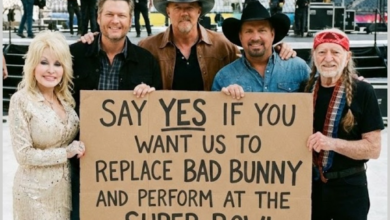
Instead of celebrity-packed performances and noise-first production, Kirk is promoting a halftime experience built around meaning, values, and intention. No shock cameos. No viral gimmicks. No manufactured controversy.
Just a broadcast framed as deliberate, reflective, and unapologetically values-driven.
To supporters, it feels overdue — a reminder that not everything meaningful has to be loud to be powerful. To critics, it feels provocative, even confrontational, precisely because it challenges a ritual so deeply embedded in American culture.
But to media insiders, the move is something else entirely: risky — and potentially disruptive.
Not Counter-Programming — A Cultural Fork

Those close to the production insist this isn’t traditional counter-programming. It’s not about siphoning viewers for the sake of competition.
“It’s about choice,” one insider said. “About asking people what they actually want to give their attention to.”
That framing is what’s making February suddenly feel complicated.
For decades, Super Bowl halftime has followed the same logic: bigger, flashier, louder. Even controversy is carefully calculated. What Kirk is offering goes in the opposite direction — and that contrast is exactly what’s resonating.
Social media reaction has been swift. Some viewers praise the courage of openly challenging the entertainment machine. Others accuse Kirk of manufacturing division by framing the choice so starkly.
But even critics admit one thing: people are listening.
Why Executives Are Quietly Nervous
Behind the scenes, the tension is real.
Several media insiders say network executives are less concerned about Kirk’s public messaging — and more concerned about one unrevealed element of the broadcast that remains tightly guarded.
While details are scarce, sources describe it as something that could “reframe the entire halftime conversation” and “linger long after the game ends.” It’s reportedly not a guest appearance, not a stunt, and not a political speech — which only deepens the curiosity.
“What’s rattling people is the restraint,” one source explained. “When you don’t know what the hook is, you can’t control the narrative.”
That uncertainty is dangerous in an industry built on predictability.
Supporters See a Reset Button
Among Kirk’s supporters, the message is being interpreted as an invitation rather than a rejection.
They argue that American entertainment has become oversaturated — louder every year, yet increasingly hollow. For them, the idea of stepping away from the spectacle for a moment rooted in clarity and values feels grounding.
“This isn’t about hating football,” one supporter wrote online. “It’s about remembering we’re allowed to choose depth over distraction.”
That sentiment is spreading fastest among viewers who feel culturally fatigued — tired of being sold nostalgia, outrage, or irony instead of substance.
Critics Warn of Polarization
Critics, however, see risk in the framing.
By explicitly telling viewers to “turn off” the Super Bowl, they argue, Kirk invites unnecessary division — positioning entertainment as a moral battleground rather than a shared experience.
Some media analysts warn that the message could alienate casual viewers who might otherwise be open to alternative programming, while hardening opposition from those who see the Super Bowl as a cultural unifier.
Yet even critics concede that controversy isn’t the engine here.
What makes this moment unusual is how calm it is.
No shouting.
No insults.
Just a clear ask.
Why the Message Is Spreading So Fast
The speed of the reaction says as much as the message itself.
In an era dominated by algorithms that reward outrage and spectacle, a quiet challenge stands out. Kirk’s words don’t demand agreement — they demand consideration.
And that may be the most disruptive element of all.
People aren’t just reacting. They’re debating. Sharing. Pausing.
For advertisers, networks, and cultural gatekeepers, that pause is unsettling. Attention is currency — and for the first time in years, a meaningful slice of it might be voluntarily redirected.
February Just Got Complicated
Whether viewers ultimately follow Kirk’s advice remains to be seen. The Super Bowl is a powerful gravitational force.
But one thing is already undeniable: the assumption that there is only one place America will look on that night has been challenged.
This isn’t just about ratings.
It’s about agency.
About whether audiences still feel empowered to choose meaning over momentum.
And with one unrevealed element still being held back, the story is far from finished.
👇 What Erika Kirk is planning, why insiders say the message is spreading faster than expected, and the detail being kept quiet until the last moment — full breakdown in the comments. Click before it explodes.