kk.“JESUS IS FOR EVERYBODY” — JELLY ROLL’S GRAMMY SPEECH THAT STOPPED THE ROOM AND SHOOK AMERICA

“JESUS IS FOR EVERYBODY” — JELLY ROLL’S GRAMMY SPEECH THAT STOPPED THE ROOM AND SHOOK AMERICA
On a night built for applause, spotlights, and celebration, Jelly Roll chose something far riskier than a victory lap. Holding a GRAMMY high in one hand and conviction in the other, he delivered a message that cut through politics, labels, and expectations — a declaration of faith and humanity so direct it froze the room, ignited debate, and instantly became one of the most talked-about moments in GRAMMY history.
The moment Jelly Roll stepped to the microphone, something felt different. This was not the posture of an artist preparing a polished thank-you speech. This was a man leaning into truth. His grip on the GRAMMY was firm, but it was clear the trophy was not the point. His eyes were locked forward, his voice raw, carrying the weight of a life that had known prisons, addiction, recovery, and redemption.
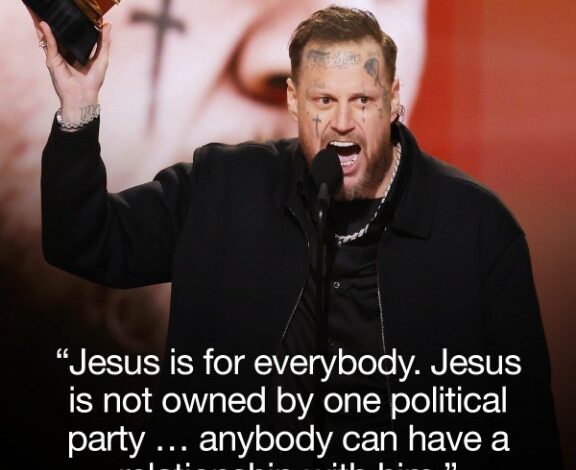
“Jesus is for everybody,” he said.
The room shifted.
It was not shouted. It was not wrapped in metaphor. It was spoken plainly — and that was exactly why it landed so hard.

In an era when faith is often packaged as a political signal or marketing tool, Jelly Roll drew a line with surgical precision. Jesus, he insisted, is not owned by any political party. Not owned by any music label. Not owned by power, ideology, or branding. Jesus is Jesus — and anybody can have a relationship with Him.
For several seconds, the room sat in a kind of stunned stillness. Applause didn’t immediately erupt. People leaned forward. Some nodded. Some stiffened. Everyone listened.
This was not a sermon designed to comfort. It was a confrontation — not with the audience, but with the way belief has been commodified and weaponized in modern culture.
Jelly Roll’s words carried weight because they came from a place that could not be dismissed as theory. He spoke of a time when all he had was a Bible and a radio inside a cell barely larger than his body. Music and faith, he said, were not abstract ideas back then — they were lifelines. They were survival.
That context transformed the speech from opinion into testimony.
This was not a celebrity borrowing faith for aesthetic effect. This was a survivor explaining what kept him alive.
The GRAMMY he held — for Best Contemporary Country Album — became symbolic in real time. Country music has always been rooted in confession, in grit, in spiritual wrestling. But rarely has that lineage been embodied so visibly, so unapologetically, on a stage this large. Jelly Roll didn’t soften his message to fit the room. He trusted the room to rise to it.
And rise it did — eventually.
When applause came, it wasn’t the explosive roar reserved for chart dominance or spectacle. It was deeper. Slower. Heavier. The kind of applause that signals recognition rather than entertainment.

Within minutes, clips of the speech spread across social media. Headlines followed. Comment sections lit up. Some called it courageous. Others called it controversial. But almost no one called it forgettable.
That reaction revealed the true power of the moment.
Jelly Roll did not tell people what to believe. He told them who belief does not belong to. In doing so, he reclaimed faith from the tug-of-war it has been trapped in for years. His message wasn’t exclusionary. It was expansive — and that made it threatening to anyone invested in ownership.
The image of him raising the GRAMMY as he spoke became iconic almost instantly. Tattoos visible. Chain heavy. Voice breaking through the noise. It was a visual contradiction to every stereotype still clinging to American music culture. A man once written off as broken, criminal, unmarketable, now standing at the pinnacle of the industry — not asking permission, not apologizing, not performing belief, but living it.
What made the speech unforgettable was its refusal to simplify. Jelly Roll did not claim holiness. He claimed humanity. He didn’t present himself as redeemed and finished, but as redeemed and still walking. That honesty echoed the very album that won him the award — a body of work that treats brokenness not as a flaw to hide, but as a truth to carry.

Critics would later argue about whether the GRAMMY stage was the “right place” for such a message. Supporters would counter that there is never a wrong place to speak truth plainly. But the debate itself proved the point: the speech had escaped the room. It had entered the culture.
In a night designed for celebration, Jelly Roll delivered a reckoning.
Not a political one. Not a religious one. A human one.
By the time the lights dimmed and the broadcast moved on, the trophy was already secondary. What remained was a sentence echoing across timelines and living rooms:
Jesus is for everybody.
In an industry built on image, Jelly Roll offered conviction. In a culture addicted to ownership, he offered release. And in a moment meant to crown success, he reminded millions that survival — honest, hard-earned survival — is sometimes the greatest victory of all.