IT WASN’T THE BIG HEADLINES — IT WAS THE SMALL MOMENTS THAT CHANGED EVERYTHING.
When the call came in earlier this week, it didn’t sound dramatic. It sounded procedural. A lineman injured on the job. Severe burns. Remote location. Weather turning dangerous. What followed, however, would quietly become one of those stories people don’t forget—not because it went viral, but because it revealed what still shows up when everything else shuts down.
Hunter Alexander is 24 years old.
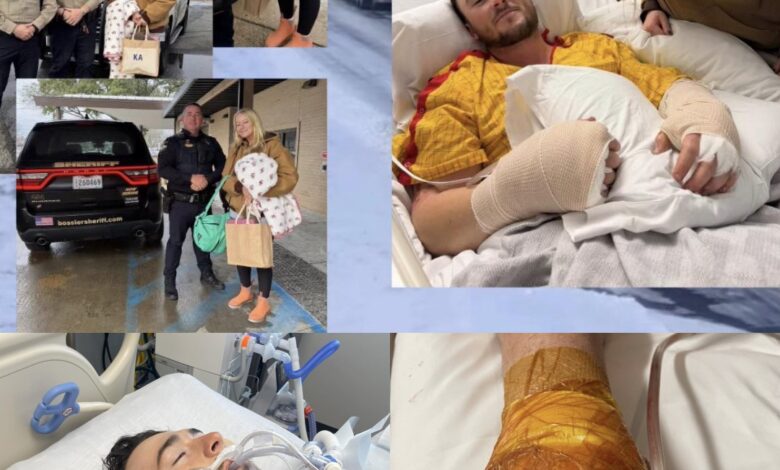
He was working to restore power in frozen Louisiana when the accident happened. Ice locked down roads. Winds cut visibility. Emergency crews did what they could, fast. Hunter was stabilized and flown to a distant burn unit—hours away—because it was the only place equipped to help him.
There was just one problem.
His wife, Katie, was stranded.
Separated When It Mattered Most
As Hunter was airlifted to specialized care, Katie found herself trapped on the wrong side of the storm. Roads were impassable. Travel advisories stacked up. Phones buzzed with updates she couldn’t act on. She knew where her husband was—but not how to reach him.
Anyone who’s lived through a medical emergency understands that particular kind of fear: knowing someone you love is fighting for their life, and being unable to sit beside them, unable to speak into their ear, unable to let them feel your hand in theirs.
For hours, there were no answers—only uncertainty.
And then something unexpected happened.
The Chain That Wasn’t Supposed to Exist
It started with one deputy.
Seeing Katie’s situation, the officer made a decision that wasn’t in any manual. He called another deputy in the next parish. Then another. Then another. With roads iced over and jurisdictions normally kept separate, law enforcement officers began coordinating something simple—and extraordinary.
They moved Katie hand-to-hand through the storm.
One patrol vehicle at a time. Across parish lines. Through back roads and checkpoints. When one route became unsafe, another officer was already waiting at the edge of his territory to take over.
No press. No cameras. No announcement.
Just people refusing to let a woman face the worst moment of her life alone.
Hours later, Katie reached the burn unit. She walked into a hospital room still humming with machines—and finally stood beside her husband.
“That’s When Everything Changed”
Family members say Hunter was sedated, but something shifted when Katie arrived. Nurses noticed it. Doctors noted subtle changes. His heart rate steadied. The room felt different.
“It wasn’t dramatic,” a family member shared. “It was quiet. But you could feel it.”
For Katie, the moment wasn’t about medical updates or next steps. It was about being there. About letting Hunter know—whether he could hear her or not—that he hadn’t been left behind.
That chain of deputies, strangers only hours before, would become part of the family’s story forever.
The Road Ahead Is Still Hard
Today, there’s real progress—but no illusions.
Hunter is officially out of the ICU, a milestone his doctors don’t take lightly. He’s now preparing for another surgery, one surgeons hope will restore blood flow and repair damaged tissue in both arms. It’s delicate. It’s complex. Outcomes aren’t guaranteed.
Every decision is still measured. Every update still comes with caution.
But the tone has shifted—from crisis management to cautious hope.
Doctors are encouraged by signs of stabilization. Family members are bracing for the long road of recovery while holding tightly to the fact that Hunter is here to fight it.
The Moment That Changed the Family Forever
Within all the medical details, there’s a smaller moment the family keeps returning to.
While Katie sat at Hunter’s bedside, one of the deputies who helped get her there sent a message. It wasn’t formal. It wasn’t heroic. It was simple—a prayer, offered quietly, with no expectation of recognition.
That message, the family says, hit harder than anything else.
“It reminded us,” Katie shared, “that none of this was random.”
In a week dominated by ice, alarms, and fear, that reminder mattered.
Why This Story Is Spreading
Hunter’s story isn’t spreading because of tragedy alone. It’s spreading because of the response to it.
In a time when systems often feel cold and fragmented, this was coordination without obligation. Compassion without a spotlight. People stepping beyond the edges of their job descriptions because it was the right thing to do.
No one involved asked for attention. But thousands of readers are stopping anyway—because stories like this cut through noise.
They remind us that while storms can isolate us physically, humanity still finds ways through.
Where Things Stand Tonight
Hunter remains hospitalized. Surgery is ahead. Recovery will take time measured in months, not days. Katie is by his side. Family and friends are rotating in. Messages of support continue to pour in from people who’ve never met them—but recognize something familiar in the story.
A young couple. A dangerous job. A moment where strangers became a lifeline.
And a reminder that sometimes, the little things—the decision to help, the choice to stay, the willingness to carry someone through the storm—are the things that change everything.
👇 The full update, including how Hunter reacted when he learned what it took to get Katie to him, is in the comments below.