LATEST UPDATE — Surgery Is Over, but the Tension Hasn’t Lifted
The operating room doors finally opened, but relief only came in measured breaths.
Hunter is out of surgery — and while there is cautious optimism, no one is calling this a turning point yet. What unfolded inside the OR brought a mix of progress and new concern, leaving doctors, family, and nurses acutely aware that the next 24 hours may carry as much weight as the procedure itself.
Right Arm: A Strategic Pause, Not a Finish Line
On Hunter’s right arm, surgeons made a deliberate decision that speaks volumes about both hope and restraint.
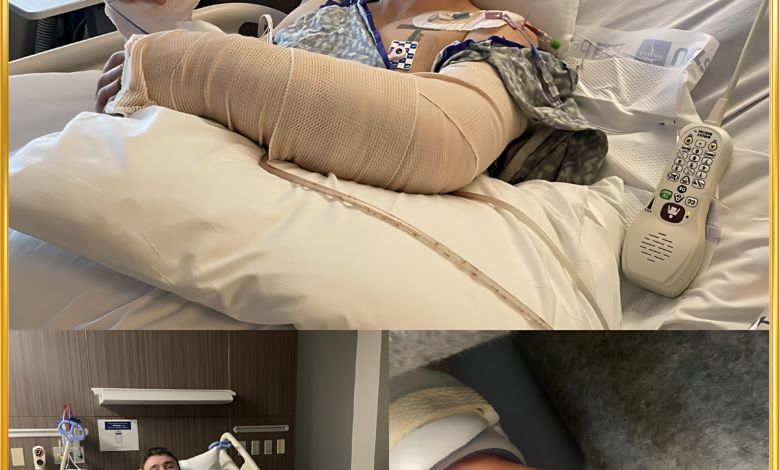
The wound vac was successfully removed. More notably, doctors chose not to proceed with a skin graft at this stage. Instead, they applied Restarta Matrix powder, a specialized regenerative treatment designed to support tissue recovery, and wrapped the arm with plans to reassess after a full week.
That choice matters.
Skipping a graft isn’t avoidance — it’s strategy. It suggests the tissue may be capable of stabilizing and regenerating without rushing into another invasive step. Surgeons want to see how the wound responds before committing to permanent reconstruction.
In medical terms, this is a vote of conditional confidence.
In human terms, it’s a reminder that healing doesn’t always move forward in dramatic leaps. Sometimes, it advances by waiting carefully and not forcing the body faster than it can safely go.
Left Arm: Where the Room Tightened

The left arm told a far more fragile story.
During surgery, doctors found the tissue to be extremely delicate, more compromised than imaging had suggested. As they worked, the ulnar artery — a critical vessel supplying blood to the hand — suffered a 5mm erosion, a small tear that instantly raised the stakes.
Surgeons placed one precise suture to repair the artery. The repair held. Blood flow was preserved.
But that moment changed everything about the postoperative plan.
Because of the risk associated with that vessel, Hunter was transferred back to the ICU, where continuous pulse monitoring can be maintained. Doctors aren’t waiting for problems — they’re watching for the slightest deviation.
If anything changes, an angiogram is already planned. No delays. No debate.
Right now, pulses are present and stable. That’s the sentence everyone is holding onto.
A Quiet Win Hidden in the Numbers
Amid the tension, one number brought genuine relief.
Hunter’s CK level dropped to 159.
For context, CK (creatine kinase) levels skyrocket when muscle tissue is breaking down under severe stress or injury. For weeks, that number has been a looming indicator of how hard his body has been fighting.
At 159, it’s low enough that doctors have officially discontinued CK monitoring.
That may not sound dramatic — but medically, it’s a meaningful milestone. It tells the team that systemic muscle breakdown is no longer driving the crisis. One major danger has eased.
Quiet victories like this don’t come with applause. They come with a subtle shift in posture, a calmer tone in the room, and a doctor finally crossing one concern off the board.
Pain Remains a Daily Battle

While labs improved, Hunter’s pain has not eased.
Postoperative pain remains intense, and medications were adjusted again in recovery to try to strike the right balance between relief and safety. Doctors are walking a narrow line — managing pain without compromising circulation, alertness, or healing.
Those closest to him say he’s exhausted but steady, responding when spoken to, grounding himself in familiar voices. Pain doesn’t erase resolve — but it does test it.
The Detail That Explains Why Doctors Aren’t Relaxing
There’s one detail from the operating room conversation that explains the tension lingering tonight.
Surgeons were clear: the repair is stable — but newly fragile tissue behaves unpredictably in the first 24 hours.
This window matters.
Swelling. Pressure. Micro-shifts in blood flow. Any one of them could change the picture quickly. That’s why ICU monitoring isn’t optional. It’s essential.
Doctors aren’t sounding alarms — but they are refusing complacency.
This is the kind of situation where outcomes are protected not by heroics, but by vigilance.
What the Next 24 Hours Mean

The next day isn’t about new procedures or big decisions. It’s about watching. Measuring. Protecting what was preserved today.
If pulses remain strong, it buys time.
If pain stabilizes, it buys rest.
If the left arm holds, it buys options.
Hunter has already beaten odds that once felt unmovable. Today added both hope and responsibility — the responsibility to guard fragile progress with patience.
Surgery may be over.
But the fight is still very much alive.
👇 The full overnight update, what ICU teams are watching hour by hour, and why tomorrow morning matters more than it seems — all details are in the comments below. Click to stay informed.