From its very first frame—mist rising over a West African savannah at dawn while drums rumble like a heartbeat—The Woman King announces itself as both epic and intimate.
Director Gina Prince-Bythewood crafts a historical drama that feels mythic without ever losing touch with the soil, the sweat, and the steel of its setting.
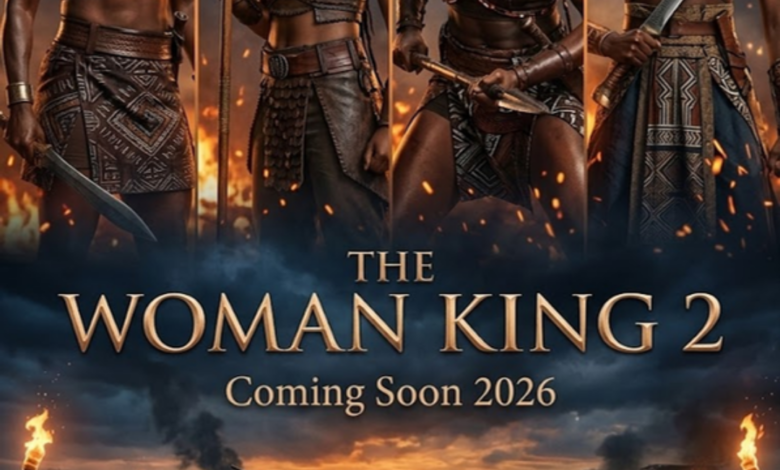
The film follows the Agojie, the all-female warrior regiment of the Dahomey kingdom, with a narrative that blends spectacle and character study in equal measure.
At its core is Nanisca (Viola Davis, formidable yet deeply human), a general hardened by battles both personal and political.
The opening ambush sequence—silent shadows moving through tall grass, blades flashing as the night erupts into controlled fury—sets a tone of disciplined violence.
But what lingers is the quiet aftermath: women sharpening their weapons, their breath steady, their eyes haunted yet resolute. This duality—glory and grief—is the film’s pulse.
Action & Adventure Films

Character is the spine of the story. Nanisca is not rendered as a flawless icon but as a woman negotiating age, memory, and responsibility. Her mentorship of Nawi (Thuso Mbedu, in a breakout performance) provides the emotional engine of the film. Nawi is fiery, stubborn, unwilling to be contained—a spark against Nanisca’s tempered steel. Their dynamic oscillates between clash and kinship, reflecting generational struggles over duty and identity. Lashana Lynch, as Izogie, provides warmth and levity that punctuate the film’s heavier beats, embodying camaraderie as fiercely as she embodies combat. Even within the context of empire and war, these women are painted as complex, contradictory, and real. The screenplay (by Dana Stevens, with a story from Maria Bello) resists flattening them into archetypes; instead, it revels in their contradictions—protectors who must also wound, leaders who must also sacrifice, warriors who still ache from scars unseen.
Movies

Formally, The Woman King is a triumph of craft. Polly Morgan’s cinematography captures Dahomey in a palette of fire-lit nights and sun-drenched fields, the landscapes both beautiful and unforgiving. The battle choreography is kinetic yet legible—no shaky cam to obscure the labor of bodies in motion. Spears crash against muskets, shields splinter, sweat sprays into torchlight. Terence Blanchard’s score braids African percussion with orchestral swells, creating a soundscape that is both rooted and universal. The production design, from regal palaces to training grounds etched with dirt and discipline, builds a world that feels lived in rather than mythologized. Each costume by Gersha Phillips tells a story: beads, textiles, and leather stitched not just for protection but as markers of culture and pride. These elements combine into sequences that are visually breathtaking while still grounded in tactile realism.
Action & Adventure Films

Thematically, the film confronts power, agency, and complicity. It refuses to shy away from Dahomey’s entanglement in the transatlantic slave trade, rendering it not as a backdrop but as a moral fissure within the kingdom. Nanisca’s arc—facing both external enemies and internal reckonings—embodies this tension. Should a nation’s survival justify compromise with systems of oppression? Can warriors who embody liberation also perpetuate cycles of harm? By placing these questions inside personal relationships—between mothers and daughters, leaders and recruits—the film makes geopolitics feel immediate, lived, and devastating. It also reframes heroism not as domination but as stewardship, as the courage to imagine a future unshackled from inherited violence. Nawi’s evolution from rebellious novice to conscious fighter mirrors this thesis: strength without reflection is incomplete.
Movies

What endures after the credits is not just the spectacle of battles won but the resonance of voices carried forward. Viola Davis delivers a performance of thunderous gravity, yet it’s Mbedu’s raw vitality that leaves an afterglow, suggesting continuity beyond legacy. The film closes on a note both triumphant and bittersweet, reminding us that liberation is never clean, and victories often bear the weight of loss. In an era saturated with action spectacles that mistake noise for narrative, The Woman King (2022) distinguishes itself as something rarer: a film that wields scale in service of intimacy, politics in service of humanity, and history in service of imagination. It does not just tell us who these women were; it dares us to feel what it might have meant to stand among them, to fight, to falter, and to rise.

And in that rising lies the film’s true legacy. The Woman King does not merely recreate a moment in history; it resurrects a lineage of courage that contemporary audiences rarely see honored with such depth and artistry. Its final moments—women standing shoulder to shoulder as dawn breaks over Dahomey—serve as both a visual benediction and a call to remember those whose stories were silenced or simplified by time. The film leaves you with the sense that history is not a distant artifact but a living, breathing inheritance, shaped by the choices of those who dared to defy the world as it was. In the echoes of its final drumbeats, you feel the weight of generations and the promise of futures forged by resilience. The Woman King is a cinematic monument: fierce, tender, unflinching, and unforgettable.
Action & Adventure Films
Watch Movie: