kk.Super Bowl 60 Faces an Unexpected Challenger — Inside the All-American Halftime Show Everyone’s Talking About

Super Bowl Sunday has always followed a familiar rhythm: the biggest game, the biggest ads, and a halftime spectacle designed to dominate conversation for days. But this year, something different is taking shape — and it’s coming from outside the NFL’s ecosystem entirely.
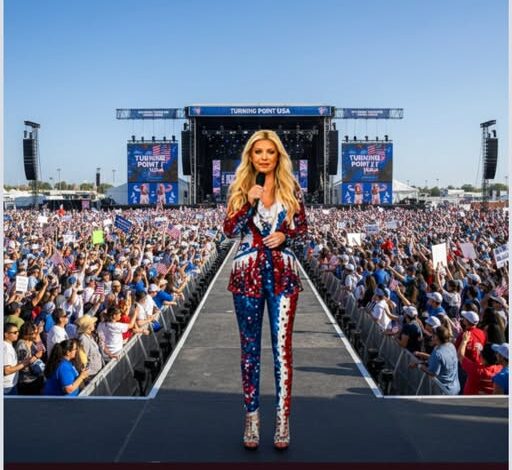
Turning Point USA has officially unveiled plans for “The All-American Halftime Show,” a patriotic broadcast scheduled to air directly opposite the Super Bowl 60 halftime window. Hosted by Erika Kirk, the program is being positioned not as a parody or reaction stream, but as a parallel option — one rooted in faith, family, and freedom, and framed as a continuation of the legacy of her late husband, Charlie Kirk.
The announcement landed quietly at first. Then the response surged.
Why the timing matters
The Super Bowl halftime show isn’t just entertainment; it’s one of the most concentrated attention moments in American media. Tens of millions of viewers tune in at the same time, making it a cultural checkpoint as much as a performance.
That’s why the decision to program an alternative during the same window is drawing scrutiny.
Supporters say the timing is intentional — a statement that viewers deserve choice during a moment traditionally dominated by a single narrative. Critics argue it’s an unnecessary provocation. Media analysts, meanwhile, are focused on the same question: Can an independent broadcast meaningfully siphon attention from the NFL’s most watched segment?
Even asking that question marks a shift.
Not framed as competition — but contrast
Organizers behind the All-American Halftime Show are careful with their language. Publicly, they avoid calling it a “counterprogram.” Instead, they describe it as an alternative vision — a space for viewers who want something different from pop spectacle and high-concept production.
Insiders describe the tone as intentionally grounded. Less flash. More message. Less shock. More symbolism.
That framing appears to be resonating with a specific audience — one that feels increasingly disconnected from mainstream halftime shows and their cultural cues. Within hours of the announcement, clips, reactions, and speculation flooded social platforms, with users debating not just what the show will include, but what it represents.
Erika Kirk at the center
Erika Kirk’s role has amplified interest. Since her husband’s passing, she has largely avoided the spotlight. Her decision to host and anchor the broadcast adds a personal dimension that supporters see as meaningful rather than performative.
Sources close to the production say the show is designed to feel intentional, not reactive — with segments built around shared national themes rather than viral moments. That approach stands in stark contrast to the fast-paced, globally marketed halftime performances viewers have come to expect.
Whether that difference attracts or limits viewership remains an open question — but it’s clearly fueling curiosity.
The mystery driving momentum
One reason the conversation keeps accelerating is what hasn’t been revealed.
Organizers have confirmed the show will include musical performances and spoken segments, but the full lineup remains sealed. More notably, they’ve declined to comment on the final moment of the broadcast — a detail insiders describe as “symbolic” and “deliberate.”
That silence is strategic. In an attention economy, mystery often travels faster than confirmation. Every refusal to clarify has prompted more theories, more threads, and more coverage.
Media executives watching from the sidelines have taken notice — not because the show is guaranteed to rival NFL numbers, but because it doesn’t need to. Even a modest share of the halftime audience would be enough to prove a point.
Two stages, two value systems
At its core, this moment isn’t just about ratings. It’s about representation.
On one side: the NFL’s halftime show, designed for global appeal, pop relevance, and mass-market sponsorships. On the other: a values-driven broadcast aimed squarely at a domestic audience that feels underserved by mainstream cultural programming.
For years, that audience has talked about wanting alternatives. Rarely has anyone attempted one at this scale, during this specific window.
That’s why the phrase “unexpected challenger” keeps surfacing — not because the All-American Halftime Show is expected to “win,” but because it exists at all.
What happens next
In the weeks ahead, more details are expected to emerge — whether through official announcements or carefully placed hints. As Super Bowl 60 approaches, the conversation will likely intensify, especially once the NFL reveals its own halftime lineup and creative direction.
At that point, the contrast will become unavoidable.
Viewers won’t just be choosing between channels. They’ll be choosing between interpretations of what halftime represents — spectacle versus symbolism, pop culture versus principle, familiarity versus intention.
Whether millions make that switch or only a fraction do, the impact may last longer than one Sunday night. Because once audiences are reminded they have a choice, the media landscape rarely snaps back to how it was before.
👇 What’s confirmed, what’s still speculation, and why the final moment matters more than the lineup — full breakdown in the comments. Click to read.