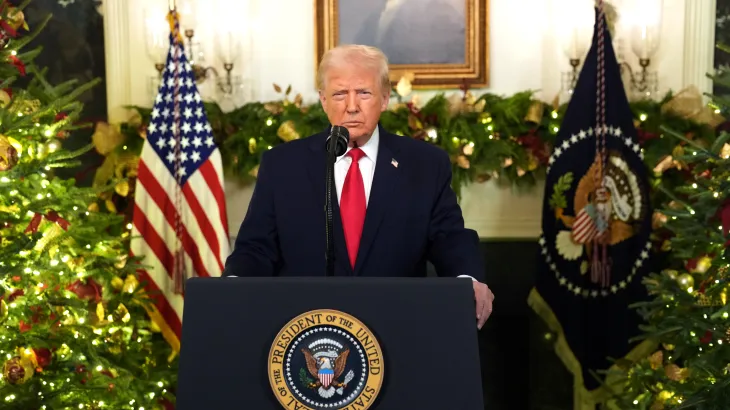
In a speech delivered from the White House, President Trump criticized Democrats and reiterated his claim that the economy is thriving, despite rising concerns over the cost of living.
The president’s 18-minute address aimed to defend his achievements during his first year in office, asserting that the “Golden Age” he promised during his 2024 campaign was gaining momentum.
As expected, much of his speech was a collection of familiar talking points often heard at White House events, rallies, and speeches. True to his style, there was an abundance of exaggerated claims and misleading statements. Notably, he steered clear of recent remarks suggesting that the issue of “affordability” was a mere “hoax” or a “scam” pushed by Democrats—a line that had previously caused discomfort among his advisers.
Here are six key takeaways from the speech:
1. A Combative Tone
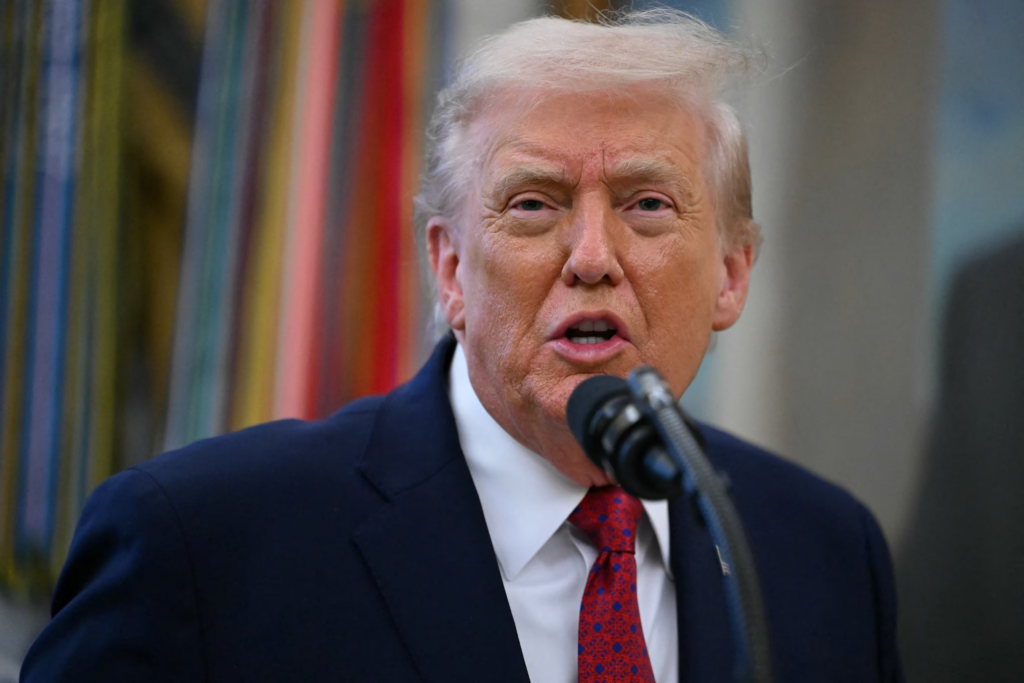
Trump’s delivery was sharp and combative. Eschewing his usual reliance on a teleprompter, he rushed through the speech as though eager to wrap it up. Unlike his more meandering address in Pennsylvania a week earlier, there were no detours or side comments here. His tone was almost frantic, reflecting a sense of urgency to prove that his first year in office had been a success.
The president began by placing blame squarely on former President Joe Biden, claiming, “I inherited a mess.” He painted a bleak picture of America from a year ago—overrun by illegal immigration, its manufacturing base decimated, and cities plagued by crime. According to Trump, all of these issues had now been resolved, and more economic relief was on the way, if Americans were willing to wait for their paychecks to grow fatter.
However, his angry tone seemed to undermine the message, perhaps revealing an underlying recognition of the pressure to deliver tangible results before any narrative about mismanagement could take hold.
2. Selective and Misleading Statistics
The president made use of dubious statistics in his speech. For instance, he claimed to have reduced drug prices by 400%, 500%, and even 600%, figures that are mathematically impossible. He also touted a significant decrease in inflation under his leadership but failed to mention that inflation had returned to 3% by September—exactly the rate it was when Biden left office. On gas prices, Trump claimed that many states had gasoline priced below $2.50 per gallon, but the Department of Energy reported an average of $2.90.
Trump also skipped over the latest unemployment figures, which showed the unemployment rate at 4.6%, the highest it had been in four years. Additionally, recent drops in factory construction spending were left unaddressed.
While it’s common for presidents to manipulate statistics to suit their narrative, Trump’s exaggerations were particularly noticeable. His arguments seemed to reflect growing concerns among his supporters, who were starting to question whether he could effectively manage the economy.
3. Risking the Same Mistake as Biden
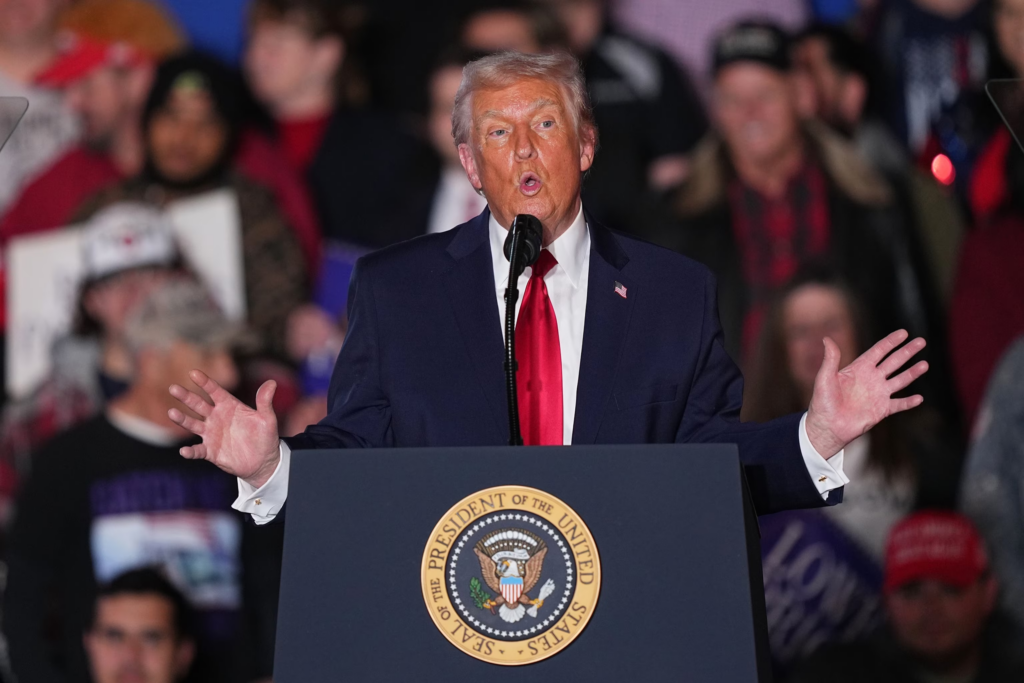
During his campaign, Trump triumphed by painting Joe Biden as out of touch with everyday Americans, who felt Biden’s optimism about the economy didn’t align with their reality. Now, Trump was in danger of making the same mistake.
Trump repeatedly insisted that Americans should be grateful for his success in bringing back manufacturing jobs and removing illegal workers from the job market. Yet, the country is still losing manufacturing jobs, and tariffs—his favorite economic tool—remain a point of contention. His argument about foreign investment flooding into the U.S. seemed overly optimistic, citing figures that were double what his own administration had reported.
It was clear that the president was struggling to convince the public that his policies were having a real, visible impact on their daily lives.
4. His Solution: Write a Check
In a move that seemed aimed at providing immediate relief, Trump promised to send out “warrior” checks—$1,776 each to 1.4 million military personnel, to mark the nation’s 250th anniversary next year.
On healthcare, Trump advocated for a $2,000 one-time payment for Americans below a certain income threshold. While this could be used to buy insurance, it was clear that this amount would be inadequate in covering the rising premiums for many families. Trump also promised that tariff revenues would allow for drastic cuts in personal income taxes, but his reliance on tariff income seemed overblown given the uncertainties around those funds.
5. Tariffs Under Threat from the Supreme Court
Trump made no mention of the looming legal challenges to his tariff regime, particularly the case before the Supreme Court, which could strike down his high-tariff policies. If the Court rules against him, the fallout could be significant, including possible demands from companies to return tariff collections.
While Trump displayed confidence in his tariffs, this legal uncertainty is a real risk for his 2026 agenda. His over-reliance on tariffs as a funding source could backfire if the Court rules against him.
6. A Self-Proclaimed Peacemaker, but No Mention of Venezuela
Although Trump spent much of his speech positioning himself as a peacemaker, he omitted mention of his recent actions towards Venezuela. Just one day before the address, Trump had posted on social media about a blockade of sanctioned oil tankers, demanding that Venezuela reverse nationalizations of American companies from the 1970s and 1990s. He threatened military action and boasted of a large naval presence.
Yet, in his speech, Trump claimed to have “settled eight wars in 10 months” and asserted that he had brought peace to the Middle East for the first time in 3,000 years. These claims, however, left much to be desired in terms of clarity, especially with ongoing conflicts like the one on the Thai-Cambodian border.
Trump’s advisers have cautioned that foreign policy successes are unlikely to be a cure-all for the challenges Republicans face in the upcoming midterm elections.