Elon Musk has once again shaken up Tesla’s artificial intelligence strategy. After shelving the Dojo 3 supercomputer project just five months ago, the Tesla CEO has now confirmed its revival—this time with a dramatically expanded vision: space-based artificial intelligence computing.
Musk claims that within the next four to five years, operating large-scale AI systems in orbit could become cheaper than running them on Earth, thanks to abundant solar energy and more efficient cooling conditions in space.
Dojo 3 Makes an Unexpected Comeback
In August 2025, Tesla abruptly halted development of Dojo 3. The decision led to the dissolution of the core engineering team, the resignation of project head Peter Bannon, and the departure of roughly 20 key engineers who later founded a startup called DensityAI.
At the time, Musk explained that it made little sense to pursue multiple, fundamentally different AI chip architectures in parallel. Tesla instead redirected its resources toward the AI5, AI6, and future chip generations—designed to support both high-performance inference and core training workloads. The company also signaled a greater reliance on external partners such as NVIDIA and AMD for computing power, as well as Samsung for advanced chip manufacturing.
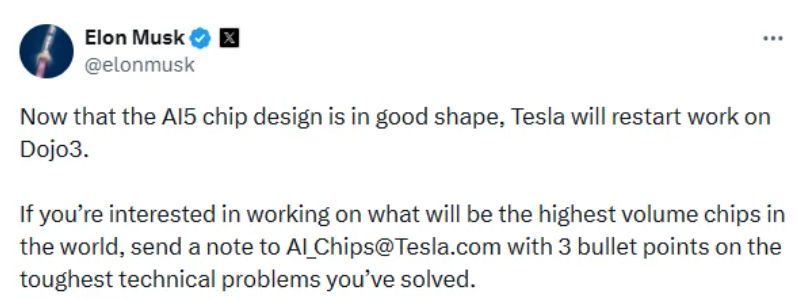
Musk’s latest announcement suggests a clear reversal of that stance. According to him, steady progress on the AI5 chip has freed up resources, allowing Tesla to restart Dojo. He even posted a public recruitment call, inviting engineers to help build what he described as “the world’s highest-yield chip,” asking applicants to summarize three major technical challenges they have previously solved.
What Exactly Is Dojo 3?
Tesla first introduced Dojo at its 2021 AI Day as a purpose-built supercomputer for machine learning training. Unlike earlier iterations, Dojo 3 represents a major architectural rethink. It abandons the highly customized D1 chip and wafer-level packaging approach used in the first two generations, focusing instead on cost efficiency and scalable design.
Musk has hinted that Dojo’s future form may resemble a large-scale cluster built from AI6 chips rather than a standalone, bespoke training system.
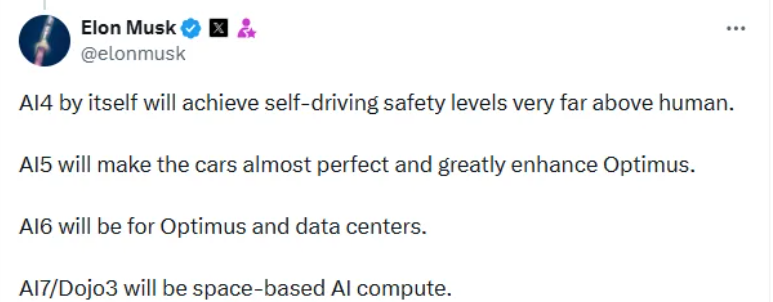
Tesla’s AI5 chip—manufactured by TSMC—is designed to support autonomous driving and the Optimus humanoid robot. Meanwhile, the company signed a $16.5 billion deal with Samsung last year to produce AI6 chips. These next-generation processors are expected to power Tesla vehicles, Optimus, and high-performance AI training workloads in data centers.
Industry analysts believe that if Dojo 3 can meaningfully reduce AI training costs while improving efficiency, it could significantly accelerate the commercial rollout of Full Self-Driving (FSD) and Optimus.
From Earth to Orbit: The “Space AI” Vision
The most striking aspect of Dojo 3’s revival is its new mission. In a recent post, Musk stated plainly: “AI7/Dojo3 will be used for space-based artificial intelligence computing.”
This aligns with a disruptive idea he floated last year—deploying AI data centers in orbit. Musk argues that solar-powered AI satellites could eventually deliver lower-cost computing than terrestrial data centers, particularly as Earth’s energy infrastructure comes under increasing strain.
According to his estimate, before planetary energy constraints become critical, space-based AI systems could achieve superior cost efficiency within just four to five years. Free solar energy and the ability to radiate heat directly into space are central to this thesis.
Musk’s overlapping leadership roles at Tesla, SpaceX, and xAI give this vision a unique degree of internal synergy. SpaceX could provide launch capabilities, Tesla could supply energy and hardware expertise, and xAI could drive large-scale model development. If successful, this ecosystem could position Musk’s companies as primary beneficiaries of an entirely new AI infrastructure paradigm.
Notably, Musk is not alone in this thinking. OpenAI CEO Sam Altman has also expressed interest in the long-term potential of placing data centers beyond Earth, citing similar concerns about power limitations on the ground.
Major Technical and Practical Barriers Remain
Despite the bold vision, space-based AI data centers face formidable challenges. Orbital debris, regulatory approval, and international space governance all introduce significant risks. NVIDIA CEO Jensen Huang has publicly dismissed the idea, calling it “just a dream.”
Thermal management is one of the most difficult technical hurdles. While space is often imagined as an ideal cooling environment, reality is more complex. Temperatures can swing from -270°C in deep shadow to +120°C under direct sunlight.
In Earth orbit, conditions vary by altitude. Low Earth Orbit (LEO) and Medium Earth Orbit (MEO) experience severe thermal cycling, inconsistent sunlight, radiation exposure, and frequent eclipses, making them poor candidates for large-scale AI infrastructure. Geostationary Orbit (GEO) is more stable, offering near-continuous sunlight and relatively lower radiation levels.
Even so, building megawatt-scale GPU clusters in GEO would require enormous radiative cooling structures. Since heat can only be dissipated via infrared radiation, gigawatt-class systems would need tens of thousands of square meters of deployable radiator panels—far beyond anything currently deployed in space.
Additionally, launching such massive systems would demand thousands of Starship-class missions. Achieving this within Musk’s proposed four- to five-year timeline appears highly unrealistic and would involve extraordinary costs.
A Vision That Pushes the Limits
The revival of Dojo 3 underscores Musk’s willingness to revisit abandoned projects when circumstances change—and to attach them to ever more ambitious goals. Whether space-based AI computing proves viable or remains speculative, the idea reflects a broader shift in how industry leaders are thinking about the future of energy, infrastructure, and artificial intelligence beyond Earth.