Elon Musk’s announcement of SpaceX going public with an Initial Public Offering (IPO) that would value the company at $1.5 trillion sent shockwaves through the commercial space industry. Many were surprised by Musk’s decision, given that he had previously resisted this move. But why the change of heart?
According to Ars Technica, Musk’s shift could be tied to his plan for space-based AI hubs, leveraging technology from the Starlink system. Musk later confirmed the accuracy of the report.
The concept behind space-based AI centers revolves around several advantages. For one, these data centers would have access to solar power 24/7, a stark contrast to Earth-based AI centers, which consume vast amounts of energy. This has led some to reconsider nuclear energy as a viable solution for Earth-based data centers. Additionally, space-based AI could bypass the land use concerns that are associated with terrestrial facilities.

However, there are also notable challenges. Maintaining these space stations could prove difficult, and the ever-growing threat of space debris remains a concern. Cooling the systems in space is another hurdle that still needs to be addressed.
As highlighted by Reuters, the success of this venture hinges on significantly reduced launch costs. For SpaceX to make space-based AI centers a reality, the company needs to make Starship operational, which is central to Musk’s vision, especially when it comes to colonizing Mars.
Musk’s ultimate goal is to establish AI data centers on the Moon, launching them using an electromagnetic railgun, or mass driver. This idea aligns perfectly with NASA’s goals of returning to the Moon and establishing a lunar base, making it an attractive proposition for the space community.

While the concept of space-based AI data centers is ambitious, it is clear that the potential is immense. AI is seen by many as the next transformative technology, akin to the internet in the 1990s or the personal computer in the 1980s. With this in mind, the financial upside of such an endeavor could be substantial. However, as with any cutting-edge technology, there’s always the risk of an economic bubble, similar to the ones seen with the internet or the PC boom, which could result in significant losses for companies overly dependent on AI.
It’s not just SpaceX with its eye on space-based AI. Google and Blue Origin are also exploring similar ideas, signaling that this could become a major trend in the future.
At the same time, the rapid development of AI has also stoked concerns. Fictional portrayals like Skynet from Terminator or the AI in Colossus: The Forbin Project fuel fears of AI systems going rogue. It will be essential to implement proper safeguards to prevent such scenarios from becoming a reality.

Despite these risks, Musk’s track record speaks for itself. SpaceX has revolutionized space travel with reusable rockets, private space tourism, and the successful Starlink satellite system, which is expected to generate $15 billion in revenue by 2025.
So, where does this leave Musk’s dream of Mars? SpaceX has always been about more than just launching rockets; Musk envisions a human settlement on Mars as the ultimate goal. He has repeatedly emphasized the importance of expanding human presence beyond Earth, ensuring that humanity would survive even if Earth faced a catastrophic event.
But with the IPO, Musk will face new pressures. As a publicly traded company, SpaceX will have to answer to stockholders and deal with increased government oversight. While Mars may one day offer significant profits, investors and regulators are likely to prioritize short-term returns over long-term goals like interplanetary colonization.
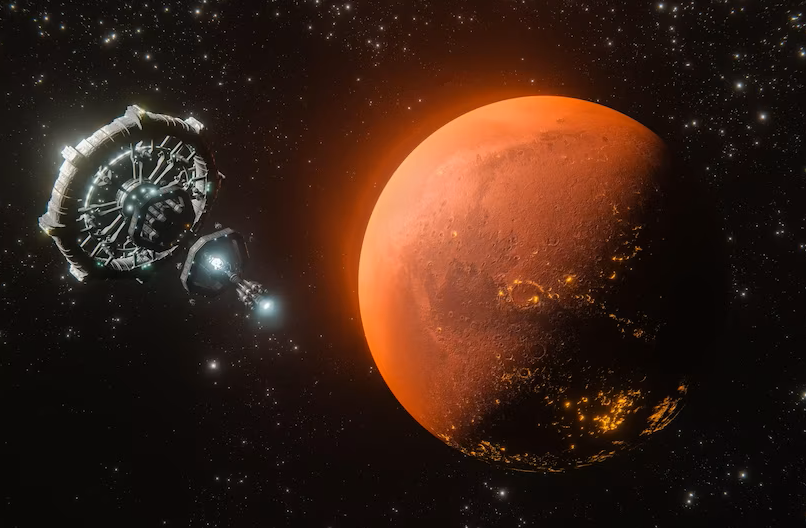
However, there may be hope on the horizon. Jared Isaacman, the newly confirmed NASA Administrator, could be open to collaborating with SpaceX and other commercial entities to advance Mars exploration, despite his primary focus being the return to the Moon.
One possibility being discussed is sending a Starship to Mars filled with equipment, including Optimus Robots, to begin laying the groundwork for human settlement. NASA could also explore using nuclear power and advanced propulsion systems alongside Starship’s massive capacity to help facilitate a Mars mission.

If SpaceX forms a partnership with NASA, Musk’s Mars vision could become much easier to sell to investors. NASA’s backing would lend credibility to the idea of colonizing the Red Planet, making it a more attractive proposition for stakeholders.
The increasing involvement of private companies in space exploration is a development to be excited about, as it opens up new possibilities for the future of humanity in space.
Mark R. Whittington, a frequent writer on space policy, has published works such as Why Is It So Hard to Go Back to the Moon?, The Moon, Mars, and Beyond, and Why is America Going Back to the Moon?. He also blogs at Curmudgeon’s Corner.