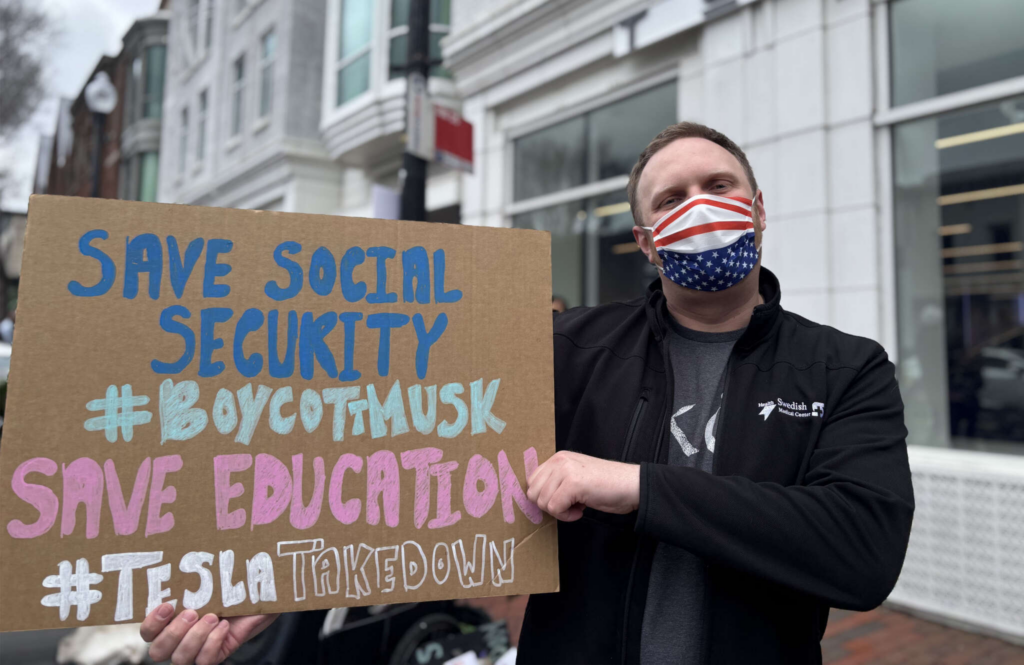
On April 26, demonstrators gathered outside a Tesla dealership in Washington, D.C., celebrating what they viewed as a hard-won breakthrough. Earlier that week, Elon Musk — Tesla’s CEO and head of the controversial “Department of Government Efficiency” (DOGE) — informed shareholders that he would scale back his government role, limiting his DOGE involvement to just “a day or two per week.”
Around the same time, Tesla disclosed in required filings with the Securities and Exchange Commission that ongoing protests posed a potential risk to the company’s stock valuation. In communications to investors, Tesla acknowledged that shifting political attitudes could significantly affect consumer demand in the near future. The company’s quarterly report underscored the pressure: profits had fallen by 71 percent.
For activists, these developments marked a milestone. When the Trump administration began, Musk’s influence expanded rapidly. On Trump’s first day back in office, DOGE was created by executive order, with Musk placed in charge and granted sweeping authority to restructure federal agencies. Musk described DOGE as a “woodchipper for bureaucracy,” and under his leadership the agency aggressively dismantled programs, terminated contracts, and dismissed career civil servants — often pushing legal and constitutional boundaries.
DOGE’s actions included effectively shutting down USAID, granting young staffers access to sensitive Treasury payment systems, and using the Office of Personnel Management to demand work reports from every executive branch employee. By mid-April, DOGE even attempted to insert government personnel into a major nonprofit organization that had previously received federal funding.
Turning to Corporate Pressure
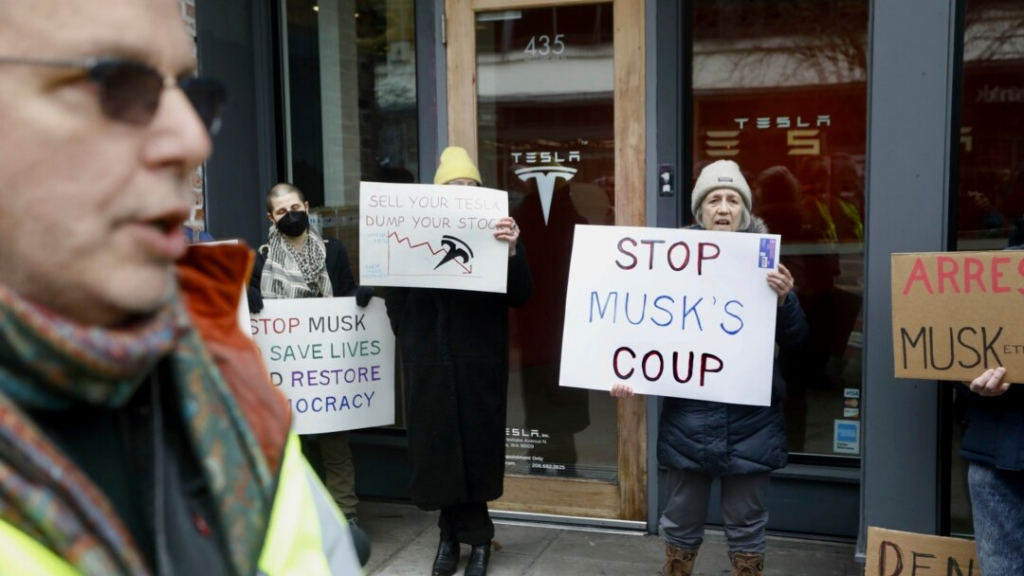
With few formal mechanisms available to challenge an agency created by executive order, opponents turned to a different strategy: damaging the Tesla brand in order to hit Musk’s personal wealth. As the world’s richest individual, Musk derives much of his fortune from Tesla shares. Protesters reasoned that if Tesla’s image and sales suffered, Musk might be forced to retreat from government power.
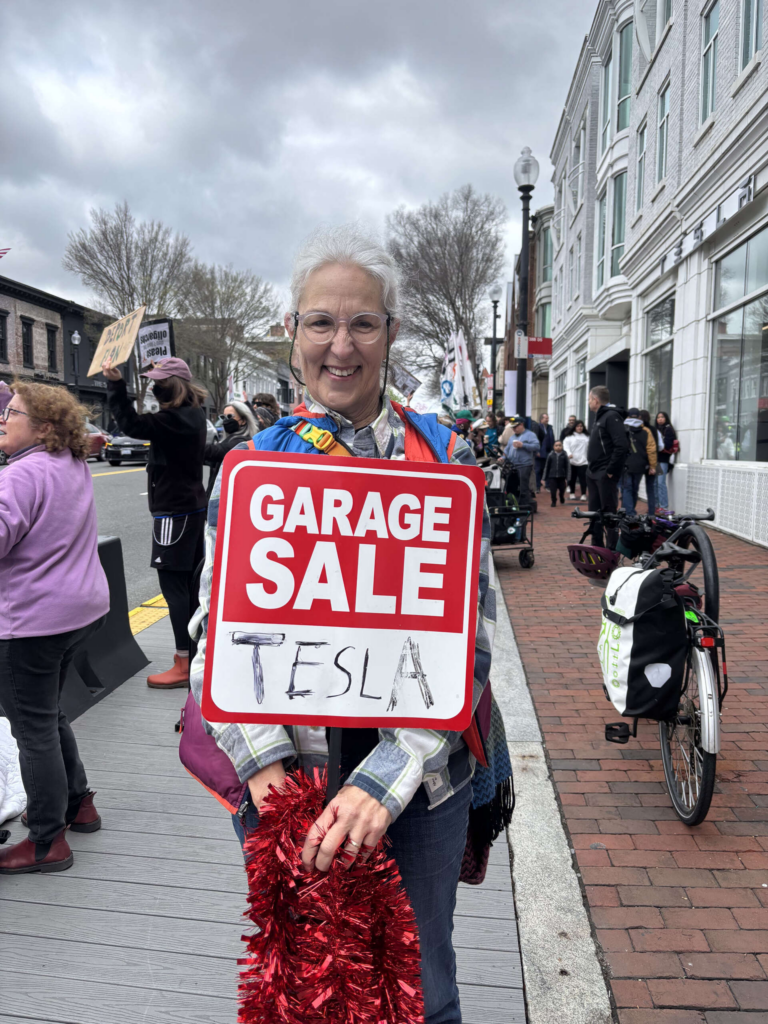
Demonstrations soon spread nationwide, with activists picketing Tesla dealerships to highlight DOGE’s impact and apply economic pressure. The Tesla Takedown campaign openly calls for consumers and investors to sever ties with the company. “Sell your Teslas, dump your stock, join the picket lines,” the group urges, framing its mission as a defense of democracy and human life.
By February, protests were appearing regularly outside Tesla locations across the United States. Their persistence helped the movement gain momentum online and on the ground. Today, Tesla Takedown lists events in 63 locations across 23 states, with additional actions held in Canada, the United Kingdom, and several European countries — particularly Germany.
In northern Virginia, near Washington, D.C., demonstrators gather outside a Tesla dealership up to three times per week, typically drawing between 15 and 35 participants.
Surveillance and Criminalization Concerns
Tesla Takedown organizers emphasize nonviolence and reject property destruction. Nonetheless, Trump administration officials have increasingly blurred the line between peaceful protest and criminal acts. Federal authorities have linked demonstrations rhetorically to isolated incidents of vandalism, arson, and gunfire at Tesla properties.
In March, FBI Director Kash Patel and Attorney General Pam Bondi labeled the most serious of these incidents — including two arson attacks and a shooting — as domestic terrorism. The FBI formed a special task force, and the Department of Justice announced it would pursue sentences of up to 20 years for the accused individuals.
Civil liberties advocates worry that this aggressive posture could extend to constitutionally protected activity. Bondi warned publicly that anyone who so much as “touches a Tesla” or protests at a dealership should expect federal scrutiny.
Michael German, a former FBI agent and current fellow at the Brennan Center for Justice, cautioned against this approach. Peaceful picketing, he argued, is fundamentally different from acts of violence, and history shows that broad intelligence efforts often end up targeting lawful activists rather than criminals.
Although federal agencies have assessed that the most serious Tesla-related attacks were likely carried out by lone actors, intelligence bulletins have encouraged law enforcement to monitor nonviolent protests closely. Fusion centers have warned that demonstrations could be exploited by “violent opportunists,” language that critics say risks framing ordinary protesters as potential threats.
Pressure From the Right
Beyond government scrutiny, protesters also face harassment from right-wing activists. Laura Loomer, a prominent far-right figure with a large online following, has repeatedly appeared at D.C.-area protests, filming demonstrators and portraying them as linked to violence. After a minor vandalism incident in New York, Loomer threatened to share protesters’ information with federal authorities.
Her influence has amplified concerns among activists, especially after President Trump echoed similar claims, suggesting — without evidence — that wealthy left-wing donors were funding Tesla-related attacks.
Responding With Joy and Visibility
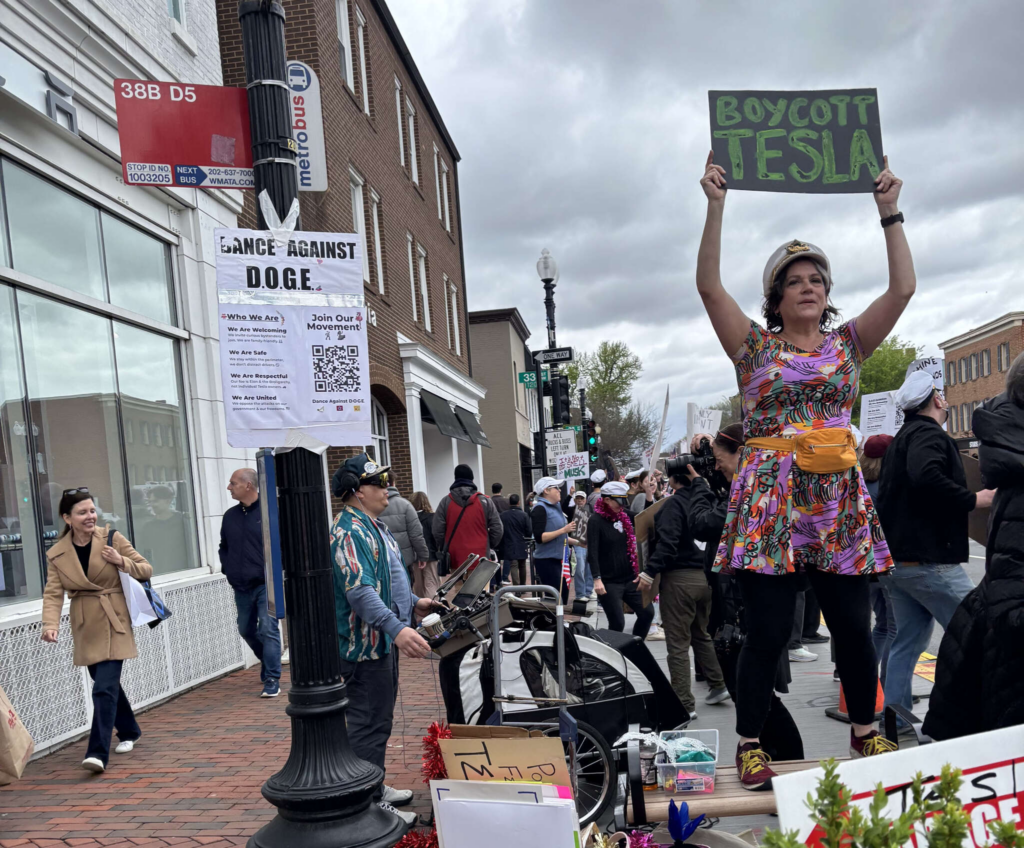
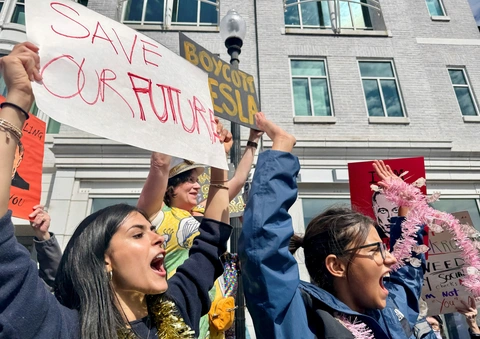
Rather than retreat, demonstrators in Washington, D.C., responded by reshaping their protests into something deliberately upbeat. The local group rebranded itself as “Dance Against DOGE,” transforming picket lines into dance parties complete with music, costumes, bubbles, and bright accessories.
Organizer Mike Kepka, known as “Captain Beats,” recalled how the first protest lacked sound equipment, prompting him to improvise with music from his minivan. Soon after, he arrived with a full audio setup powered by boat batteries. The festive atmosphere, participants say, has helped defuse tension and undermine attempts to portray the protests as dangerous.
To counter misinformation, activists now distribute flyers emphasizing their commitment to nonviolence and clarifying that their criticism targets Musk, Trump, and billionaire power — not individual Tesla owners.
“As the protests evolved, they became more joyful and more creative,” said organizer Melissa Knutson. “When critics post videos mocking us for dancing with bubbles, it actually neutralizes their attacks.”
What Comes Next
Although Tesla’s profits have dropped and Musk has pledged to reduce his DOGE involvement, protesters say their work is far from finished. Even if Musk exits government entirely, Knutson warned, DOGE staff will continue implementing cuts and restructuring programs.
Some Tesla Takedown chapters are now expanding their focus beyond dealerships, pushing local governments to divest pension funds from Tesla stock. Early signs suggest momentum: in March, 23 New York State Assembly members urged the state comptroller to divest from Tesla, and Ontario recently canceled a Starlink contract amid rising anti-Trump sentiment.
In the Washington, D.C., region, activists are exploring similar campaigns in Montgomery County and Takoma Park.
For those dancing outside Tesla showrooms week after week, the protests have come to symbolize something larger than opposition to a single billionaire.
“This is about helping people feel empowered to show up and use their rights,” Knutson said. “Some people join a dance party who’ve never protested before.”
Kepka echoed the sentiment as music blared and demonstrators sang along. “It’s joyful, nonviolent, and accessible,” he said. “If that gets more people involved, maybe that’s how democracy survives.”