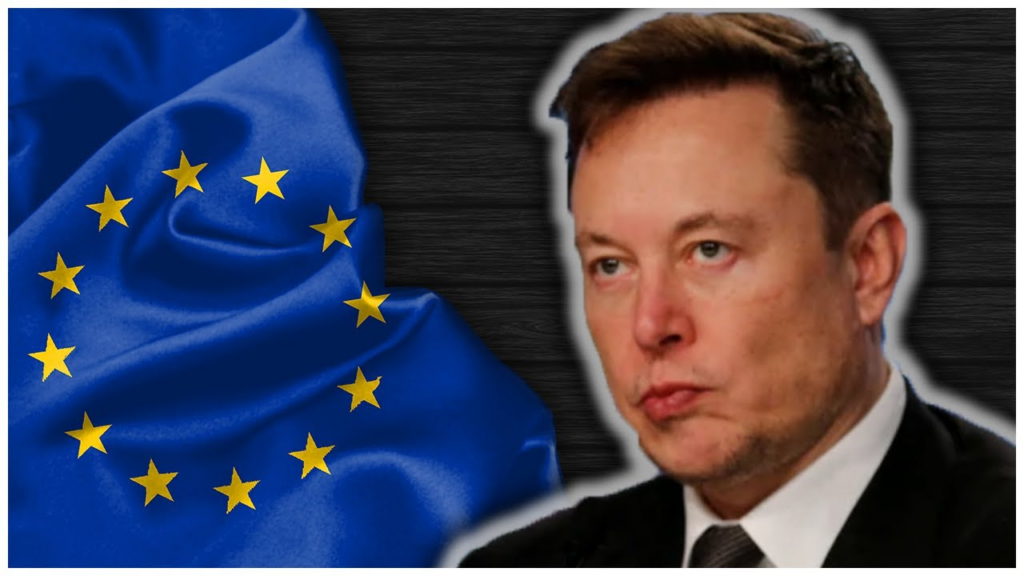
Elon Musk — billionaire tech mogul and owner of X — is no stranger to public feuds. Over the years, he has openly battled with everyone from fellow Silicon Valley figure Sam Altman to U.S. President Donald Trump.
His newest confrontation, however, is with the European Union, which he recently labeled a “bureaucratic monster” that, in his view, “should be abolished.”
So what triggered this latest dispute?
Why Did the EU Fine X?
The conflict stems from the EU’s Digital Services Act (DSA), legislation introduced in 2022 to regulate online platforms by enforcing standards on content moderation, transparency, and accountability.
In late 2023, the EU launched a formal investigation into whether X was complying with the DSA. The inquiry examined the platform’s approach to combating illegal content and misinformation, as well as its advertising transparency practices.
Last Friday, the European Commission issued its ruling: X violated the DSA in three areas and must pay a €120 million (about $210 million) penalty.
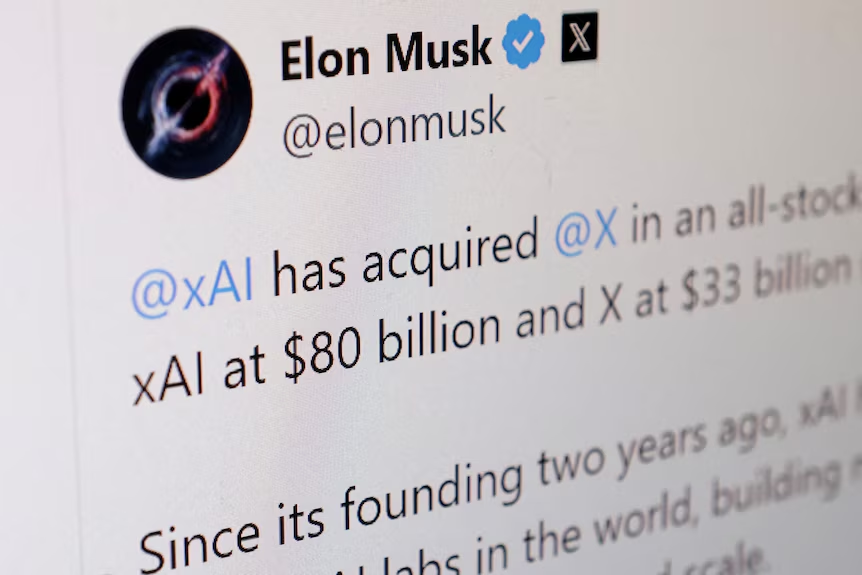
1. Misleading Blue Checkmarks
Prior to Musk’s acquisition, the blue verification checkmark was reserved for high-profile public figures such as celebrities, politicians, and other verified individuals.
After Musk’s takeover, the badge became available to anyone subscribing for $8/month. Regulators found that this change allowed virtually anyone to purchase verification without proving their identity — a system they argued could facilitate impersonation, fraud, or other deceptive practices.
2. Inadequate Advertising Transparency
The DSA requires platforms to maintain a searchable database of all advertisements, including who funded them and their target audiences.
According to the Commission, X’s advertising database contained significant design and access obstacles, including slow processing times, hindering researchers’ ability to track scams, disinformation, or coordinated influence campaigns.
3. Barriers to Research Access
The Commission further stated that X created unnecessary obstacles for researchers seeking access to public data.
Separately, X is still under investigation regarding its handling of illegal content and manipulation efforts.
How Did Musk Respond?
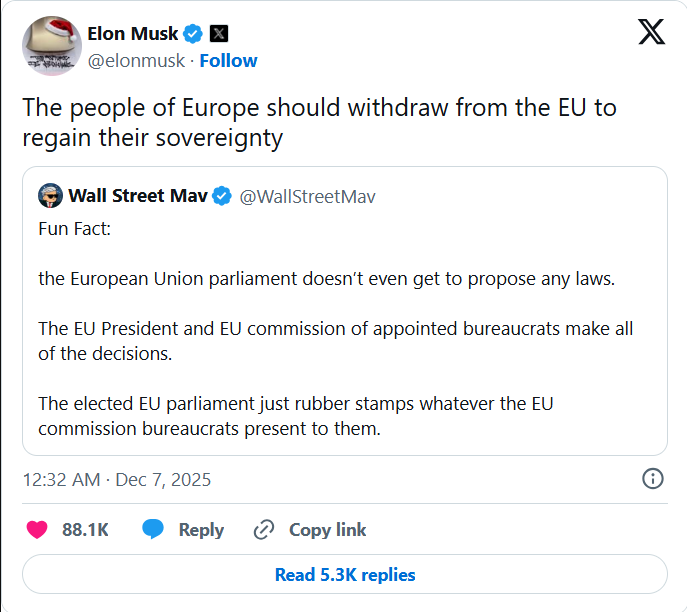
Musk reacted fiercely. He replied “bullshit” to the EU’s announcement post, and soon after told his 230 million followers that the EU “should be abolished.”
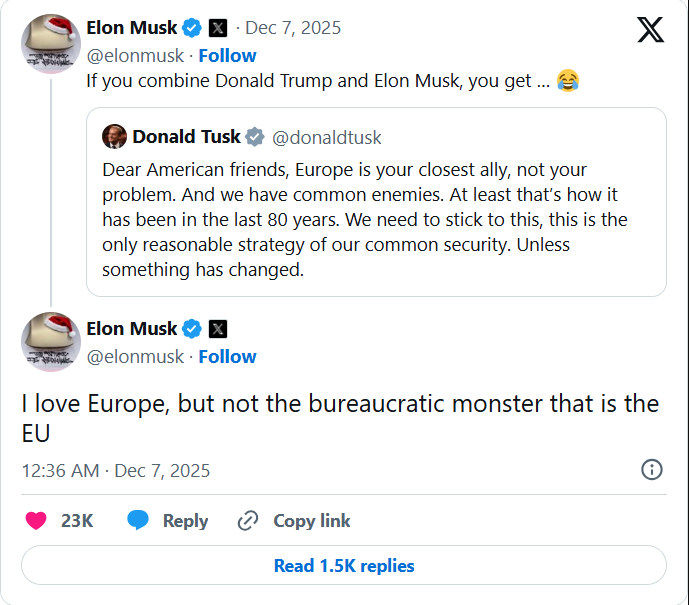
He went further, declaring that Europeans ought to “withdraw from the EU to regain their sovereignty,” adding: “I love Europe, but not the bureaucratic monster that is the EU.”
Musk also reshared memes mocking the European Union, including one portraying it as the “Fourth Reich.”
Which U.S. Officials Have Commented?
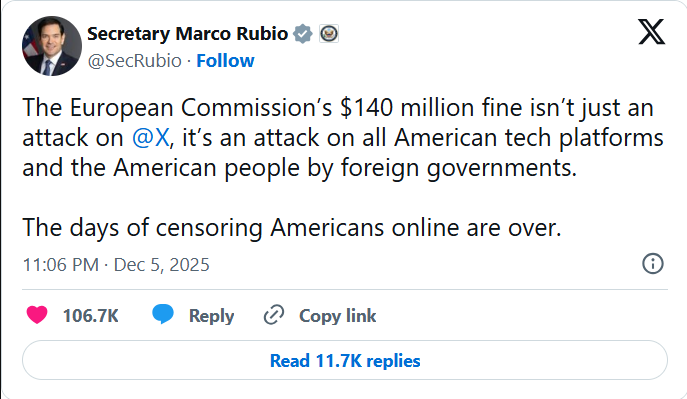
Several prominent U.S. political figures criticized the EU’s actions:
- Donald Trump called the fine “a nasty one” during a White House press briefing, expressing confusion over how the EU justified such a penalty.
- Secretary of State Marco Rubio said the move represented an attack not just on X, but on American technology companies as a whole.
- Vice-President JD Vance argued the EU’s decision infringes on free speech, writing that Europe should be “supporting free expression, not targeting American companies over nonsense.”
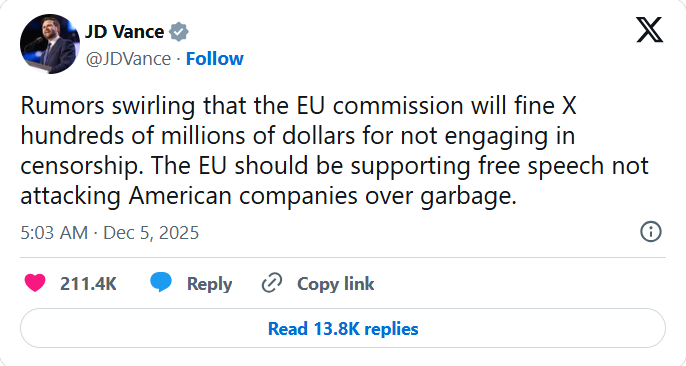
X did not immediately provide a comment when contacted.
What Is the EU’s Position?

EU officials pushed back against Musk’s claims, insisting the regulations are applied evenly and are not intended to silence major tech platforms.
Paula Pinho, the EU’s chief spokesperson, stated that freedom of speech includes the right to make “completely crazy statements,” but regulatory obligations must still be met.
Another spokesperson, Thomas Regnier, emphasized that the Commission’s actions were based solely on a transparent, democratic legal process — not on nationality or corporate origin.
European government officials, including Germany’s Digital Minister Karsten Wildberger, stressed that the bloc’s digital rules apply universally. France’s Digital Affairs Minister Anne Le Henanff praised the Commission’s decision as “historic,” saying it shows Europe can move from rhetoric to meaningful enforcement.